


Look to the left, look to the right - everything my eye catches is in yellow-blue. In front of me is the imposing Rocky Mountaineer at Vancouver's Special Station. Soon, over 750 passengers in more than 50 wagons, pulled by two powerful diesel locomotives, will be on their way to the Rocky Mountains. I am sitting in car number 6 in seat 2 and am full of curiosity about what awaits me in the coming days. My destination is the train station in Banff, Alberta. The journey takes me by train through the impressive landscape of the Rocky Mountains.

Vancouver main station is too small for the Rocky Mountaineer
Before the train departs, I am picked up from the Fairmont Hotel by a shuttle bus. Check-in for this part of my trip is already conveniently done in the hotel lobby. I will not see my suitcase again until the next hotel room, as the Rocky Mountaineer staff will take care of the luggage during the entire trip.
The bus takes me and numerous other guests to the train station specially built for the Rocky Mountaineer, as Vancouver's main station is too small for the exceptionally long train and the 750 passengers who are to board. The spacious station concourse is filled with melodic piano music played by a talented older gentleman on a grand piano, performing pieces from around the world. Coffee and souvenirs are available for guests. Apparently, this is an additional source of income for the company, because many visitors buy a wide variety of merchandise at the stalls and later on the train.

The entire scene before departure reminds me in a strange way of the movie "4:50 p.m. from Paddington" with Miss Marple, especially as the moment of boarding approaches. A bagpiper in a kilt stands at the exit doors and plays impressively on his instrument. It's time to say goodbye. Goodbye, Vancouver! I now enter the fascinating world of the Rocky Mountaineer.
The "King Class": The "GoldLeaf" Category on the Train
The train offers a choice of three different comfort categories. The RedLeaf category corresponds to a carriage as we know it from the Intercity, with comfortable seats and a similar view to that of SilverLeaf guests. However, RedLeaf passengers have to manage their luggage independently. In the SilverLeaf, on the other hand, passengers enjoy panoramic windows that reach almost to the ceiling for an impressive view.
The most luxurious category, however, is the GoldLeaf. Here, the double-decker cars are particularly noteworthy: The exclusive restaurant area is located in the lower section, while passengers are seated in comfortable seats above, allowing them to enjoy an almost undisturbed panoramic view of the landscapes lying to the side of the route. I find this to be a great advantage over the other two classes, as the route often runs along picturesque bushes and natural scenes for long periods, which are particularly accessible to passengers in the GoldLeaf cars.
While we marvel at the vastness of the land, the other guests catch glimpses of branches, bushes and forest landscapes. We get a taste of these picturesque views during meals in the Rocky Mountaineer's on-board restaurant. On board, breakfast and lunch are served in two groups to provide a comfortable ambiance for all guests. The exquisite food is thanks to the dedicated kitchen team, which is responsible for two carriages.

There is no shortage of staff on board. There are five attentive employees in charge of our carriage on the upper deck, who always provide us with drinks and snacks. They also take the time to explain the "points of interest" - the particularly interesting points along the route - and answer our questions. Through their expertise and cordiality, the staff contributes significantly to an unforgettable travel experience.
Salmon wherever the eye looks
There are countless points of interest (POI) on the way to Banff. The long train of the Rocky Mountaineer meanders leisurely along rivers and meadows as it approaches the majestic Rocky Mountains. As an avid angler, I immediately notice the abundance of salmon. The fish move upstream to spawn and then die. "This year, the salmon migration was particularly intense," reports Jeff Pelletier, a Rocky Mountaineer employee. "At times, you could barely see water, so many red salmon backs were shimmering out of the floodwaters." For me, used to the Baltic Sea, that's hard to imagine. But from the train I see so many salmon that I can imagine it very well at the end. Too bad I don't have my fishing rod with me.
The Fraser River is world-renowned for its abundant salmon stocks and is home to more salmon - including its tributaries - than any other river system in the world. An estimated ten million salmon return to the Fraser's system to spawn each year.

As the Rocky Mountaineer crosses the scenic Fraser Valley and heads towards Kamloops, we cross the historic Fraser River Swing Bridge, built in 1904. This impressive steel structure stretches from New Westminster to Surrey, connecting the two cities. In a way, the bridge reminds me of an Eiffel Tower lying horizontally, which adds to its architectural elegance and stability. Driving along this scenic route offers not only breathtaking views of the countryside, but also of significant engineering achievements of the past.
Our journey continues to Fort Langley, through the picturesque Fraser Valley, over the Harrison River Bridge and finally to Hell's Gate. At this point, the Fraser River narrows to an impressive 33.5 meters, with over 909 million liters of water flowing through per minute. For those who want to catch a spectacular view of this natural wonder, there is the option of doing so from a bird's eye view: Swiss engineers have constructed a cable car gondola that descends 152 meters into the gorge and transports visitors safely to the other side of the gorge.
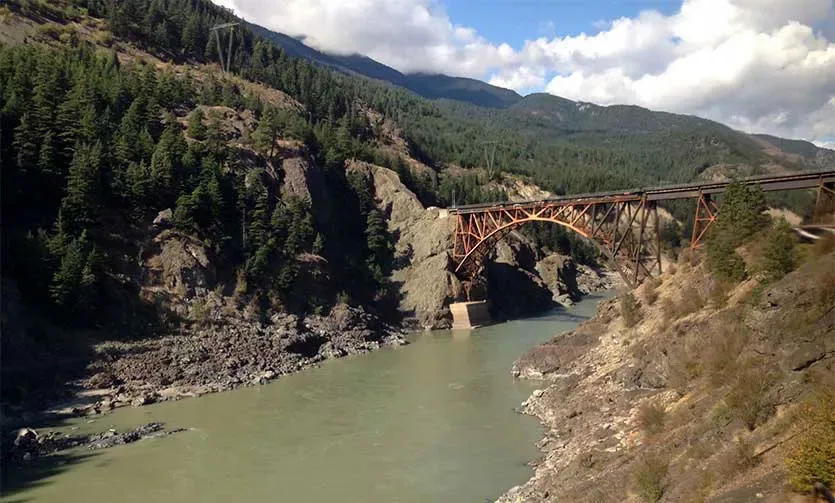

The name Hell's Gate comes from the explorer Simon Fraser, who thoroughly explored the river in 1808 and gave this impressive section its distinctive name. The dramatic narrowness and the raging masses of water left a lasting impression on Fraser, who called the passage the "gate to hell.
Passing the "Last Spike" with the Rocky Mountaineer
The Rocky Mountaineer doggedly makes its way toward Kamloops, slowing as it approaches the next historic site. We reach the "Last Spike of the CN Rail," the site where the last nail on the CN line was driven by the Canadian Pacific Railway on November 23, 1885. However, the nail is not visible from the train. After so long, it should have rusted away long ago anyway. About 40 miles further on, the Thompson River widens and flows into Kamloops Lake. With this we have reached the destination of our today's stage.

In Kamloops we set up camp for the night. This small town served as a trading center for the Secwepemc or Shuswap Indians for thousands of years. In 1812, the Pacific Fur Company established a fur trading post at the point where the North Thompson and South Thompson Rivers meet. In 1821, the first fort was built here, which further boosted trade in the region.
We don't get to see the city itself, as our bus drops us off right in front of the hotel and, at least for me, the jet lag slowly takes effect. The nine-hour time difference is too much for my biorhythm, and after a short dinner I am drawn to bed. Tomorrow morning at 6:30 a.m. the bus is already waiting to take us to the train. On the second day, we finally head for the majestic Rocky Mountains, where more breathtaking views and exciting adventures await us.
Note on our own behalf: This article was partly supported by tour operators, restaurants, hotels, airlines and/or tourism agencies. We attach great importance to independent and neutral reporting; therefore, the opinions, impressions and experiences of the respective authors correspond to their personal views.
Advertising: The links marked with an asterisk (*) are affiliate links (advertising).